

Ordering custom nurse scrubs with a logo starts with the needs of your healthcare team. The garments should fit the work, follow your facility's uniform policy and remain suitable for the approved laundry process. Branding and personalisation come after those requirements.
For a clinic or hospital buyer, the useful goal is a clear specification: what staff will wear, how names and logos will appear, and how the order will be approved. This guide explains the decisions to make before requesting quotes or committing to production.
Start with the facility's uniform policy
Check who is authorised to select and approve scrubs. Depending on the organisation, the decision may involve nursing management, procurement, the laundry provider and the infection prevention team.
Record any rules about colours, sleeves, fit, identification and changing arrangements. Do not assume a colour identifies the same role in every healthcare setting. Use your organisation's approved system.
Ordinary nurse scrubs should not be treated as protective equipment. A logo, fabric description or custom design does not establish fluid-barrier performance or infection protection. The CDC's Standard Precautions guidance identifies risk assessment and appropriate PPE as part of patient-care precautions.
If staff need protective garments for particular tasks, specify those separately through the facility's approved process. This article concerns team uniforms rather than selecting clinical protective equipment.
Define the garments and practical features you need
Build the scrub specification around the staff role. Ask wearers what they need during normal tasks, including movement, coverage and access to permitted pocket contents.
| Requirement | Question for the team | Sample check |
|---|---|---|
| Top fit | What reach and coverage are needed? | Check bending, reaching and sitting. |
| Trouser fit | Which waist and length options are required? | Check comfort through normal movement. |
| Pockets | What may staff carry under local policy? | Check access and how the garment hangs. |
| Fabric | Which care and comfort requirements apply? | Assess feel, opacity and laundry compatibility. |
| Identification | Which logo and role details are permitted? | Check readability alongside the staff badge. |
When exploring custom nurse scrub options and scrub pants, ask which specifications can be met. Do not assume a particular pocket layout, stretch content or size range is included.
Compare the top and trousers as a complete outfit. Staff may need different sizes for each piece, so avoid recording only a single set size unless that matches the proposed ordering arrangement.
Confirm fabric and laundry compatibility
Request the proposed fibre composition, construction, weight and care instructions. Descriptions such as “breathable,” “easy-care” or “long-lasting” need a clear explanation for the particular garment.
Tell the supplier how the scrubs will be cleaned. Include the facility's required wash and drying process, approved cleaning products where relevant, and whether laundering is managed centrally or by staff.
The CDC's healthcare laundry guidance discusses uniforms and scrub suits and identifies facility responsibilities for laundry arrangements or cleaning guidance. Use the requirements applicable to your setting rather than adopting a generic home-care routine.
Illustrative product styling
Plan a coordinated scrub set
Compare garment details, fit requirements and logo placement for your nursing team.
Explore custom nurse scrubs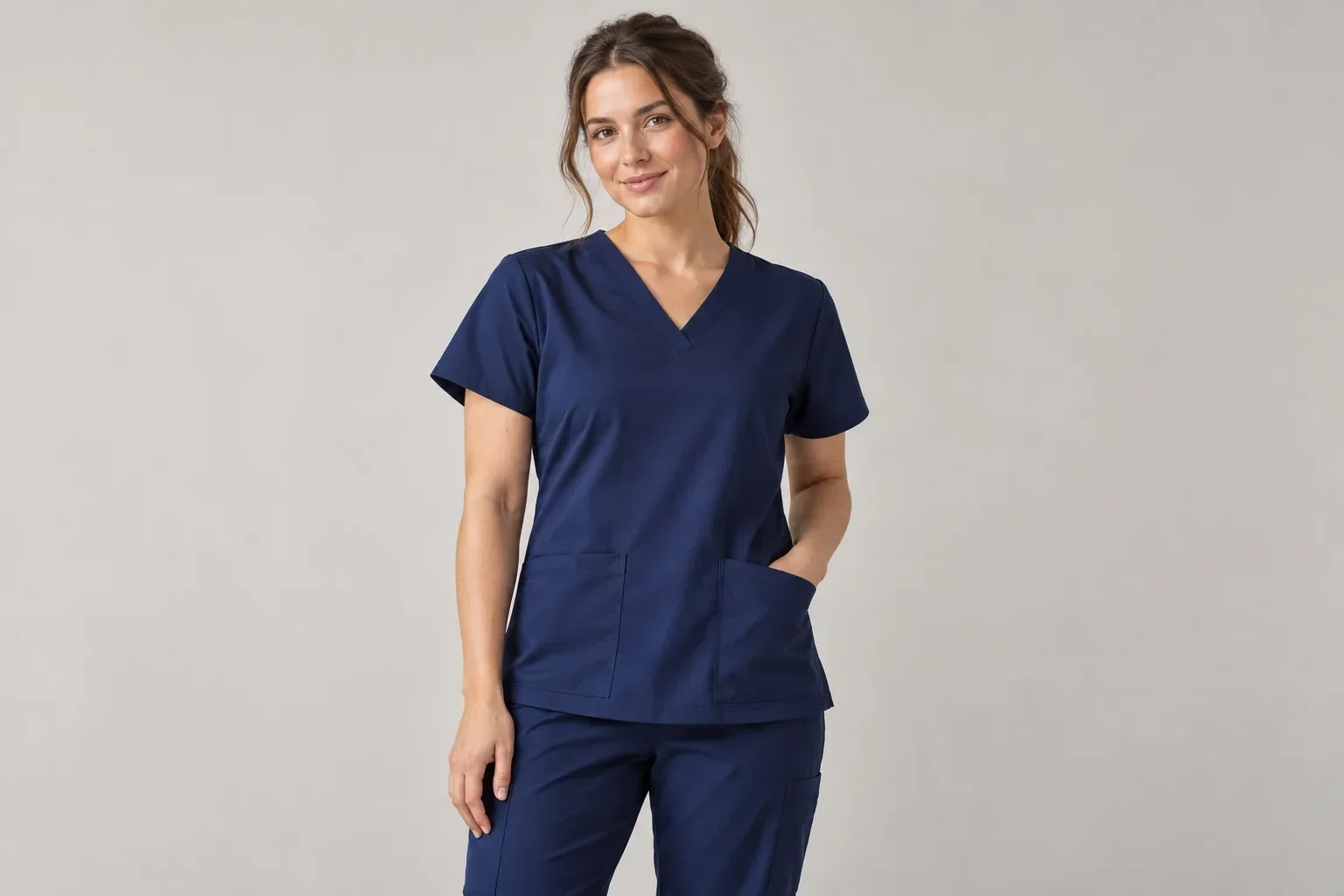
Check the complete decorated garment, including thread, printed details, waistband components and trims. A fabric that tolerates a process does not prove every other component will do so.
If wash performance matters to the order, agree a sample assessment before approval. Record the process used and inspect dimensions, colour, seams and decoration afterwards. An appearance check does not establish microbiological cleanliness; the facility's approved laundry process remains a separate requirement.
Plan logos, names and role information
Custom logo nursing scrubs can create a coordinated staff appearance. They do not automatically increase patient trust or replace formal staff identification.
Provide the approved organisation logo, colour references and proposed placement. Check that it remains visible when staff wear their usual badge, permitted layers or required PPE. Avoid crowding the chest with several competing details.
For personalised scrubs, agree exactly what information may appear. That might be an approved name format, job title or department. Follow the facility's identification and staff privacy rules rather than assuming a full name should be embroidered.
Create one controlled personalisation list. Have an authorised reviewer check spelling, titles, sizes and garment allocation before production. Keep personalisation optional where team policy requires that flexibility.
Also consider replacements. Named garments need individual ordering records, while a standard role-based design may offer more flexibility for shared stock where facility policy permits it.
Evaluate embroidery and printing on an actual sample
Embroidery creates a textured design using stitched thread. Printing covers several different processes, so ask the supplier to identify the proposed method and explain its suitability for the garment.
Small text and detailed logos need careful preparation. Madeira's guidance on embroidery puckering identifies stitch density, tension, needles and backing among the factors affecting fabric distortion.
Assess lettering at its finished size, then feel the reverse of the decorated area. Check whether the position and backing are comfortable during normal use.
Do not accept an unrestricted promise that logos will never fade or always tolerate commercial laundering. Confirm compatibility with the actual care process and any agreed performance criteria.
A digital mockup helps approve layout. It cannot demonstrate skin contact, fabric movement, fit or wash performance.
Collect sizes and calculate team quantities
Obtain the size chart for the proposed garment and clarify whether it gives body measurements or finished-garment dimensions. Size labels alone do not establish fit.
Illustrative product styling
Review scrub trouser requirements
Check trouser fit and size details against the needs of staff and your facility policy.
Explore scrub pants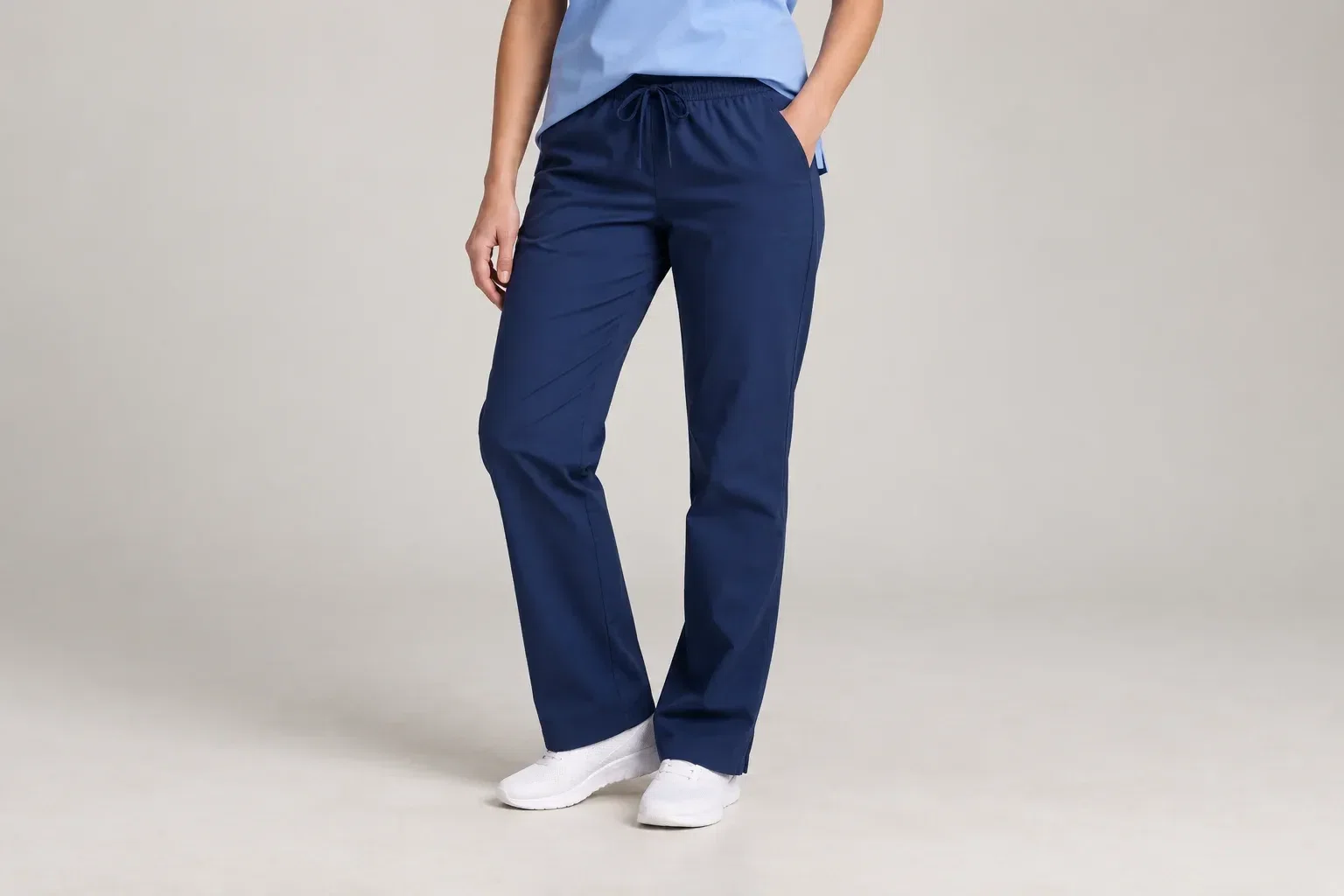
Where practical, arrange a fitting review with staff representing the required size and fit needs. Assess normal movements and coverage, including with any permitted underlayers.
Calculate quantities from staffing, shift patterns and laundry turnaround. Include the facility's arrangements for changing soiled clothing, spare stock and new starters. There is no universal number of scrub sets suitable for every team.
Keep the final order list organised by garment type, size, colour and personalisation. Record who approves changes so a late correction does not create conflicting versions.
Compare the full cost of a team scrub order
Affordable custom nurse scrubs are those that meet the agreed requirements at an acceptable total cost. A low advertised price is not enough to compare suppliers.
Ask each supplier to quote the same specification and separate:
- Scrub tops and trousers, including the size breakdown.
- Logo decoration and artwork preparation.
- Names, titles or other individual details.
- Samples and approval arrangements.
- Packing, delivery and applicable taxes.
- Repeat-order charges and minimum quantities.
For a hypothetical clinic, a standard logo across the team with optional approved names could be one brief to evaluate. Compare its quote with the required alternative rather than assuming personalisation is free or always necessary.
Ask about small replacement orders as well as the initial rollout. Confirm estimated timing, artwork retention and how material changes will be communicated. Do not assume a supplier accepts single-set orders.
A final approval checklist for healthcare buyers
- Policy: confirm colours, garment requirements and permitted identification.
- Specification: record fabric, construction, fit and care details.
- Samples: review movement, coverage and decoration.
- Laundry: confirm compatibility with the facility's process.
- Order list: approve quantities, sizes and personalisation.
- Supply terms: confirm the quote, estimated schedule and reorder arrangements.
For a wider healthcare uniform programme, retain the approved specification and a reference sample where practical. Use them to review later orders and document authorised changes.
Prepare your nurse scrub enquiry
Start with policy, fit and laundry requirements, then approve the logo treatment and team order list. This gives the supplier a clearer brief and gives your organisation a consistent basis for review.
To discuss custom nurse scrubs with StitchBase Uniform, request a team scrub quote with quantities, garment requirements, sizes, approved artwork, personalisation details and the required delivery date. Include your laundry conditions and expected replacement needs.
StitchBase Uniform manufactures to the buyer's agreed requirements and provides free mockups before production. Each client has a dedicated production manager. Minimum order and estimated turnaround are confirmed with the quote.
Frequently Asked Questions
Common questions related to this article.